Post-Crisis Housing Markets

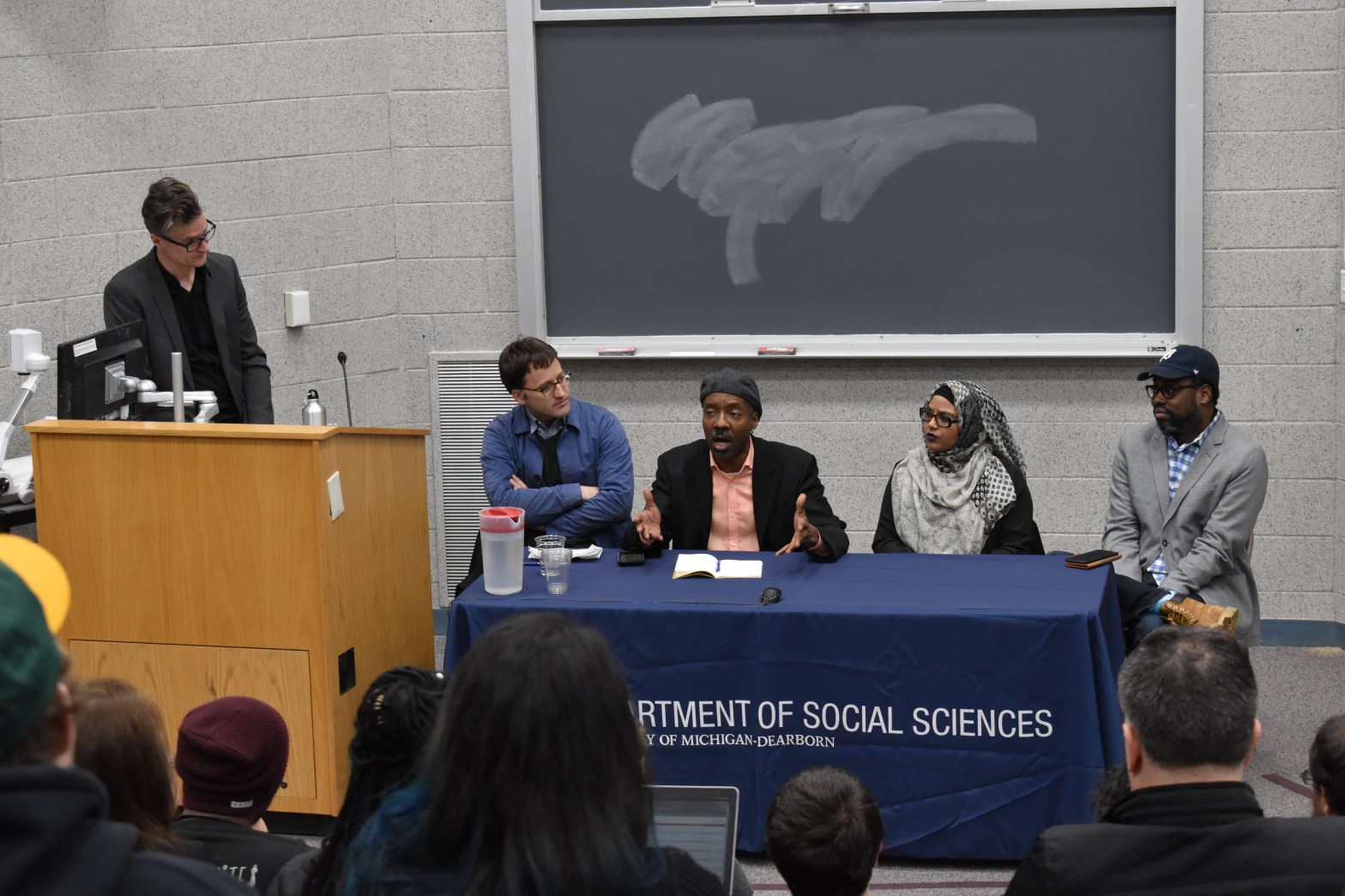
In late November, the Urban Praxis Workshop hosted a panel “Post-Crisis Housing Markets and Housing Insecurity. Reporters covering housing issues from The Detroit News and the Detroit Free-Press along with scholars and organizer Wade Rathke discussed growing housing insecurity across the country and the conditions faced by those living in Detroit.

Panelists:

Wade Rathke, Chief Organizer ACORN International

Christine MacDonald, The Detroit News

Allie Gross, Detroit Free Press

Eric Seymour, Post Doctoral Fellow, Brown University

Moderator: Josh Akers, Urban Praxis Workshop, University of Michigan-Dearborn

The panel was made possible through support by UM-Dearborn Urban and Regional Studies Program, UM-Dearborn Social Sciences Department, and the UM Detroit School.

#dismantlingdetroit Instagram posts sources

#dismantlingdetroit link to sources

Over the course of the project many of the posts include quotes. Below are the links to these references. They are organized under speculator name.

Manuel “Matty” Moroun

https://www.youtube.com/watch?v=I9F6gyDCGQU


Melvin Washington

https://www.mlive.com/news/detroit/index.ssf/2010/03/could_former_detroit_councilwo.html


Michael Kelly

http://www.fox2detroit.com/news/local-news/detroit-mom-of-four-hit-with-16000-water-bill-for-new-house


Gideon Pfeffer

https://activerain.com/profile/constantcashflow16

https://www.youtube.com/watch?v=Ao-5FGETezk

http://www.dbusiness.com/September-October-2017/30-in-Their-Thirties-2017/#GideonPfeffer


Chris Ilitch

https://www.metrotimes.com/news-hits/archives/2017/09/12/how-the-ilitches-used-dereliction-by-design-to-get-their-new-detroit-arena

https://www.freep.com/story/news/local/michigan/detroit/2018/07/10/detroit-historic-district-ilitch/770800002/


Steve Hagerman

https://www.clickondetroit.com/news/defenders/detroit-landlord-jailed-for-code-violations-including-apparent-black-mold-raw-sewage-at-home

https://www.facebook.com/pg/brickhomemgmt/reviews/?ref=page_internal


Wendy Briggs

https://www.freep.com/story/news/local/michigan/detroit/2015/11/03/commercial-blight-detroit/73600778/


Dennis Elliot

https://www.freep.com/story/news/local/michigan/detroit/2018/08/17/detroit-home-values-real-estate/921453002/


Matthew Tatarian

MacDonald, C (2011) Pot bust site tied to land speculator. The Detroit News Aug. 26

https://www.detroitnews.com/story/news/local/detroit-city/2016/08/31/detroit-launches-legal-attack-delinquent-taxpayers/89682396/

http://mapdetroit.blogspot.com/2010/11/michael-kelly-matthew-tatarian.html


Eddie Hobbs

https://www.irishcentral.com/news/irish-tv-star-s-property-firm-leaves-poor-detroit-tenants-with-no-heat

https://www.irishcentral.com/news/irish-tv-star-s-property-firm-leaves-poor-detroit-tenants-with-no-heat

https://www.independent.ie/business/irish/detroits-loss-is-hobbss-gain-30080088.html


Bert Dearing Jr.

https://www.bertsentertainmentcomplex.com/team


Mikhail Grigoryan

None


Henry Ford Health Systems

https://www.detroityes.com/mb/showthread.php?3487-The-Lincolnshire-amp-DeVur-to-be-demolished

http://detroitfireanalytics.squarespace.com/#high-risk-fire

http://www.hourdetroit.com/Hour-Detroit/May-2014/Deconstructing-Detroit/


Sameer Beydoun


http://motorcitymuckraker.com/2013/09/27/big-detroit-property-firm-accused-of-global-ponzi-scheme/

https://www.freep.com/story/money/business/john-gallagher/2017/10/10/detroit-federal-prison-housing-scam/730810001/


Gerardo Lozano

None


Dennis Kefallinos

https://detroit.curbed.com/2017/8/9/16118556/kefallinos-detroit-hamtramck-for-sale

https://www.detroitnews.com/story/news/local/detroit-city/2017/10/01/detroit-water-crackdown-fraud-unit/106224332/


Jasmine McMorris

https://tinyurl.com/ydg45b2o

http://www.crainsdetroit.com/article/20170122/NEWS/170129975/property-auction-prices-increase-as-values-climb

http://www.fox2detroit.com/news/local-news/detroit-woman-claims-rental-property-is-unlivable


Ralph Sachs

https://www.freep.com/story/news/local/michigan/detroit/2015/03/31/detroit-blight-lawsuits/70695200/


Paige Lynn

None


Odair Ali Murray

https://bit.ly/2C63zky


Timothy Bakeman

http://bankrupt.com/misc/mieb18-40003.pdf


Mohamad Bazzi

https://www.detroitnews.com/story/news/local/detroit-city/2016/02/29/land-contracts-detroit-tax-foreclosure-joel-kurth/81081186/


Aamir Farooqi

https://www.nationalgeographic.com/taking-back-detroit/see-detroit.htmlhttps://www.nationalgeographic.com/taking-back-detroit/see-detroit.html


Marin Szumanski

maxim-holdings.com/rebuilding_detroit_program.pptx

maxim-holdings.com/about-us/


James Green

None


Darin Mclesky

http://denovorealestate.com/our-team/


Grigo

None


Retland

None


Fisher

None


Skender Izairi

None


Jeffrey Cusimano

https://www.detroitnews.com/story/news/special-reports/2017/10/05/detroit-evictions-lifecycle/106350680/

https://www.businessinsider.com/detroit-landlords-skirting-tax-debt-rebuying-foreclosed-homes-2011-9


Szkardek

https://www.nytimes.com/2017/03/13/business/dealbook/rent-to-own-firm-real-estate-vision-property.html?module=Uisil

https://vpm3.com/our-story


Frank/Frenz/Franz Ivezaj

http://www.michiganrecon.com/index.php?p=mission.html

http://www.michiganrecon.com/index.php?p=d01.html


SM Jagan

None


Christian Meyer

https://www.facebook.com/CityLivingDetroit/posts/857637414295822


Gene Carlson

https://www.zillow.com/profile/GeneCarlson/#reviews


Melanie Zara

None


Abner Berkman

None


Xavier Brown

None


Silvan Radunz

None


Edward Azar

MacDonald, C (2011) Out-of-state owners seek quick profit: More snap up parcels to flip them, but critics say parcels often are neglected, add to blight. The Detroit News. Feb. 3.


Fernando Palazuelo

https://www.mlive.com/business/detroit/index.ssf/2014/06/detroits_packard_plant_owner_i.html


Steve Miho

None


Bill Wheels

None


Dawn McNamara

None


Matthew Leavitt

None


Ali Karem

https://www.facebook.com/networkrealtyllc/


Tom Rich

https://connectedinvestors.com/member/tom-rich


Linda Rogers

None


Bradford Anderson

None


Fabian Tan

https://www.metrotimes.com/detroit/a-mess-in-court-could-force-13-detroit-families-from-their-homes/Content?oid=2201757


Peter Scherer

None


Theinnhan Ton

None


James Haddrill

https://money.cnn.com/2014/10/07/real_estate/detroit-house/index.html


Deidra Banks-Story

None


Ronald McCombs

None


Bill Parker

None


Clifford Townsend

None


Gary Hepburn

None

Igor Belozersky

None


Justin Ashness

None


Krystal Kline

None


Scott Williams

https://www.facebook.com/pg/scottwilliamssells/about/?ref=page_internal


Lee Paul

None


Tai Man Fai

None


William Branham

None


Moses Shepherd

https://money.cnn.com/2009/10/16/real_estate/Real_estate_bargains.moneymag/index.htm


Kwame McKinnon

http://lansingcitypulse.com/article-4251-Eyesore-of-the-week.html


June Jackson

None


Razi Noor

None


Greg Felt

https://connectedinvestors.com/member/greg-felt


Douglas Dymarkowskil

None


Eric Norton

None

#dismantlingdetroit Data and Methods

#dismantlingdetroit

Details:
Two properties a week between September 2018 and September 2019.
70 speculators are included
105 properties are featured
References for quotes in posts may be found at urbanpraxis.org, references are organized under owner’s last name.
A detailed project statement is available at urbanpraxis.org

Data:
City of Detroit Assessor 2017
Property Praxis 2017
RealtyTrac
CoreLogic
LexisNexis Public Records

About:

Over the past three years, we have reviewed over 500,000 public records related to limited liability companies (LLCs) to identify ownership within these companies. Individuals named self-identified in these documents as an executive or member of the LLC.

We have built a database of ownership and companies based on public records and the use of proprietary databases that compile public records nationwide. Our information is only as accurate as these records.

An issue in working with property data is that patterns and practices are more easily identified at larger scales, i.e. cities, counties, states … The more granular the level of analysis the higher the likelihood of errors. This is due in large part to the dynamic nature of property markets (the speed and ease of exchange, particularly with low cost property) and the arcane rules and sluggish bureaucracy that catalogues transactions.

Methods:

We identified properties using the 2017 Property Praxis data set. This data set catalogues speculative holdings in the city of Detroit. Property Praxis defines speculation as owners with five or more properties in various states of repair without a taxable address in the neighborhood.

The Property Praxis data set is built from an analysis of the 2017 City of Detroit Assessor file. It also includes property sales in the Wayne County Tax Foreclosure auction which the City Assessor has not updated since 2014.

For LLCs with a volume of properties to qualify as a speculators, owners were identified by reviewing documents related to that company available in the State of Michigan’s LARA database. When LLC information was not available in this database, the LLCs home state database was searched. In addition to utilizing publicly accessible databases we have also subscribed to LexisNexis Public Records which compiles public records across the United States.

In cases where ownership is in doubt, we have cross-referenced the City of Detroit Assessor data with sales records from RealtyTrac through 2015 and CoreLogic through 2017.

Properties were identified by volume of ownership. Two-thirds of the speculators featured in this series own 100 or more properties. Properties for high volume owners were further narrowed by cross referencing addresses with the blight ticket data available on the City of Detroit Open Data Portal. In the case of small volume owners these properties were kept because they were representative of all of these owners property holdings and their LLC names referenced investment.

We photographed properties between late June and mid-August 2018. In all, we covered over 350 driving miles in the City of Detroit.

#dismantlingdetroit

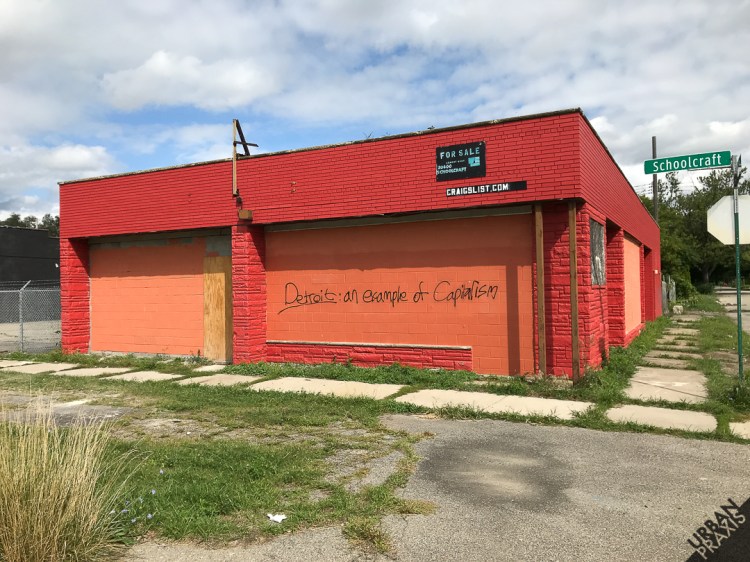
20600_Schoolcraft_20180830

Over the next year, the Urban Praxis Workshop is featuring two speculator owned Detroit properties per week. These images will appear on our social media feeds with an initial post on Instagram @urbanpraxiswork, on the Urban Praxis Workshop Facebook page, and a link to the Instagram post on Twitter. We hope you will follow and add to the conversation on these speculators and their properties. Posts will begin on Sept. 11, 2018.

Each photo includes the property address, speculator name, the companies they do business as, and the number of properties owned in the city. Where available we have included quotes about their practices, a review from a tenant, or the speculators own words on their business. The images were taken in the summer of 2018 by Urban Praxis Workshop members. We drove over 350 driving miles in the city. The work is based on speculator data by Property Praxis. Their data is based on City of Detroit Assessor information and Wayne County Tax Auction sales.

Our intent is to demonstrate that decline is an active practice, that there are actual people, companies, and organizations that produce it and by making those things visible we are adding our work to that of many others in the city to widen avenues for organizing to change it.

Background:

The continuing decline of Detroit is driven by exploitation and profiteering in many of the city’s poorest neighborhoods. Real estate speculation is one of the primary methods and one of the most destructive. It extracts the limited financial resources of residents and tears apart the fabric of neighborhoods. The neglect of these houses and commercial structures by bulk owners result in blight and vacancy. The cost of these practices fall on residents who have the misfortune to sign a contract with these speculators, neighbors who watch houses crumble or sit vacant, and the general public who is left with the cost of demolishing these structures once these speculators walk away.

These speculative practices are directly tied to the rising rates of eviction in the City of Detroit. Low income housing markets were changed by the financial crisis. A variety property schemes relying on land purchase agreements, such as land contracts, have become commonplace. Eviction is a key component of these strategies. It is not merely the result of the precarity of poverty. It is a feature in this system of exploitation.

Where did this come from:

This market did not emerge on its own. It was made possible by a mortgage collapse that changed ownership patterns, a housing crisis in cities like Detroit where affordable quality housing is in limited supply, and the actions and inaction of government at all levels to intervene in protecting their most vulnerable residents while enabling those with means to exploit them.

What are some of the factors that led to this:

These practices are enabled by the Wayne County Treasurer and the annual tax auction. Wayne County has avoided bankruptcy by collecting millions in revenues and fees from low income residents behind on property taxes. The volume of tax foreclosures was higher because the City of Detroit over-assessed homeowners. The City of Detroit made it incredibly difficult for low income residents to receive the property tax poverty exemption they qualified for. These practices emerged from the financial crisis when government sponsored agencies such as Fannie Mae chose to sell bank foreclosures in bulk in Detroit and other struggling Great Lakes cities to speculators. Hundreds of millions in public money has been doled out to private contractors for demolition. Much of that money was intended to keep people in their homes during the mortgage crisis. The State of Michigan adopted policies that made it difficult for anyone to qualify for these funds. The City of Detroit and Quicken Loans lobbied the Obama Administration to use this money for demolition.

This project is an attempt to make the work of academic researchers and housing activists and advocates accessible to a wider audience.

The Urban Praxis Workshop is a community-driven research cooperative housed at the University of Michigan-Dearborn.  For more information on our work you can find us at urbanpraxis.org or contact us at urbanpraxis@umich.edu


Animating the Housing Crisis – video


In 2017, we had the pleasure of working with Detroit videographer and filmmaker Justin Ivory and Space Monkey Productions. Ivory is working on short documentary on the housing crisis in Detroit and focused some of his work on Detroit Eviction Defense and the case of the Bishop who lost his house in a foreclosure scam.

Though the documentary is still in progress, Ivory shared this short animation drawn from our research at the Urban Praxis Workshop and work of Detroit Eviction Defense, a mutual aid organization dedicated to working with and organizing those fighting to for their place.


Title: Nobody Moves
(Short Documentary, in progress 2018)
Director: Justin Ivory
Production: Space Monkey Productions
Posted with permission of Justin Ivory and Space Monkey Productions
All rights Justin Ivory and Space Monkey Productions

Race and Region: It’s still standing but no one is standing still

The Urban Praxis Workshop and the University of Michigan-Dearborn hosted a community forum on Race and Region in late March. It was a discussion that drew on the power of legacies and their monuments, the necessity of new metaphors in engaging white supremacy, the resonance of past experiences and present engagements with racial division in Southeast Michigan and beyond, and how segregation can be defined in part as a hoarding of resources.

A story map on Orville Hubbard and Dearborn that complements the forum is here.

The forum and map were created by Urban and Regional Studies students in the Fall 2017 Intro course.

Forum Panelists:

Stephen Henderson, Journalist, Host WDET’s Detroit Today.

Namira Islam, Co-Founder and Executive Director, Muslim ARC

John Patrick Leary, Associate Professor of English, Wayne State University

Lester Spence, Associate Professor of Political Science and Africana Studies, Johns Hopkins University

Moderator: Joshua Akers, Assistant Professor Geography and Urban and Regional Studies, University of Michigan-Dearborn


Infrastructures of Violence and Inequality

DSC_0006

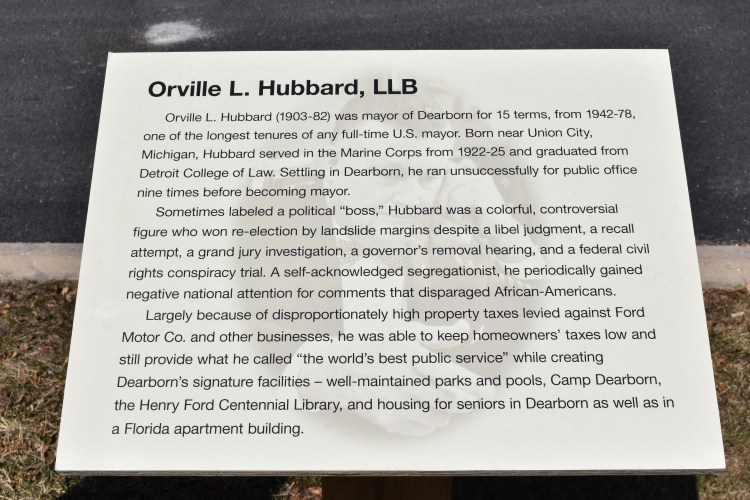
The city of Dearborn continues to wrestle with its racist reputation nearly 40 years after its 15 term segregationist Mayor Orville Hubbard died. This struggle is personified in the city officials insistence on keeping a life-size bronze statue of Hubbard on display in public space.

Nearly 200 people gathered at the University of Michigan-Dearborn to hear from a panel of academics, journalists, and activists for a forum to discuss the Hubbard statue and the ways in which race shapes and continues to shape the region. The discussion began with the monument to Orville Hubbard now outside the Dearborn Historical Society but quickly turned to a discussion of the infrastructures of violence and inequality that persist and the need for points of disruption not only at an individual level but of the system of white supremacy.

DSC_0167

What to do with Hubbard’s statue led to a deeper conversation on the infrastructure of racism and its persistence. Each of the panelists engaged with the ways in which the past is maintained in the present as it is represented in Hubbard, embodied in the way one teaches their child how to drive slowly through Dearborn just as their mother had 34-years prior, or losing access to the Dearborn Public Library in junior high because of the color of your skin.

DSC_0005

As Lester Spence put it, “racism is a political process of hoarding resources.” It is not about the attitudinal interaction but power. The ability to provide good schools, public amenities like parks and library through tax revenue and the governing structures to prevent those outside from accessing it defined Hubbard’s legacy.

For the panelists, what Hubbard, and his 15 terms as mayor represented, were not the infrastructure of services he built within the city of Dearborn but the lengths to which he would go to prevent others from accessing those services.

The forum was conceived of and planned by students in the Intro to Urban and Regional Studies class at the University of Michigan-Dearborn. Panelist were Lester Spence, Stephen Henderson, John Pat Leary, and Namira Islam.

Urban and Regional Studies students built an interactive story map to accompany the forum. You can find it by clicking here or on this site under the project tab.

For more on Hubbard check out David Good’s Orvie: The Dictator of Dearborn. It is out of print. The local library is your best bet.


On Speculation and Organizing

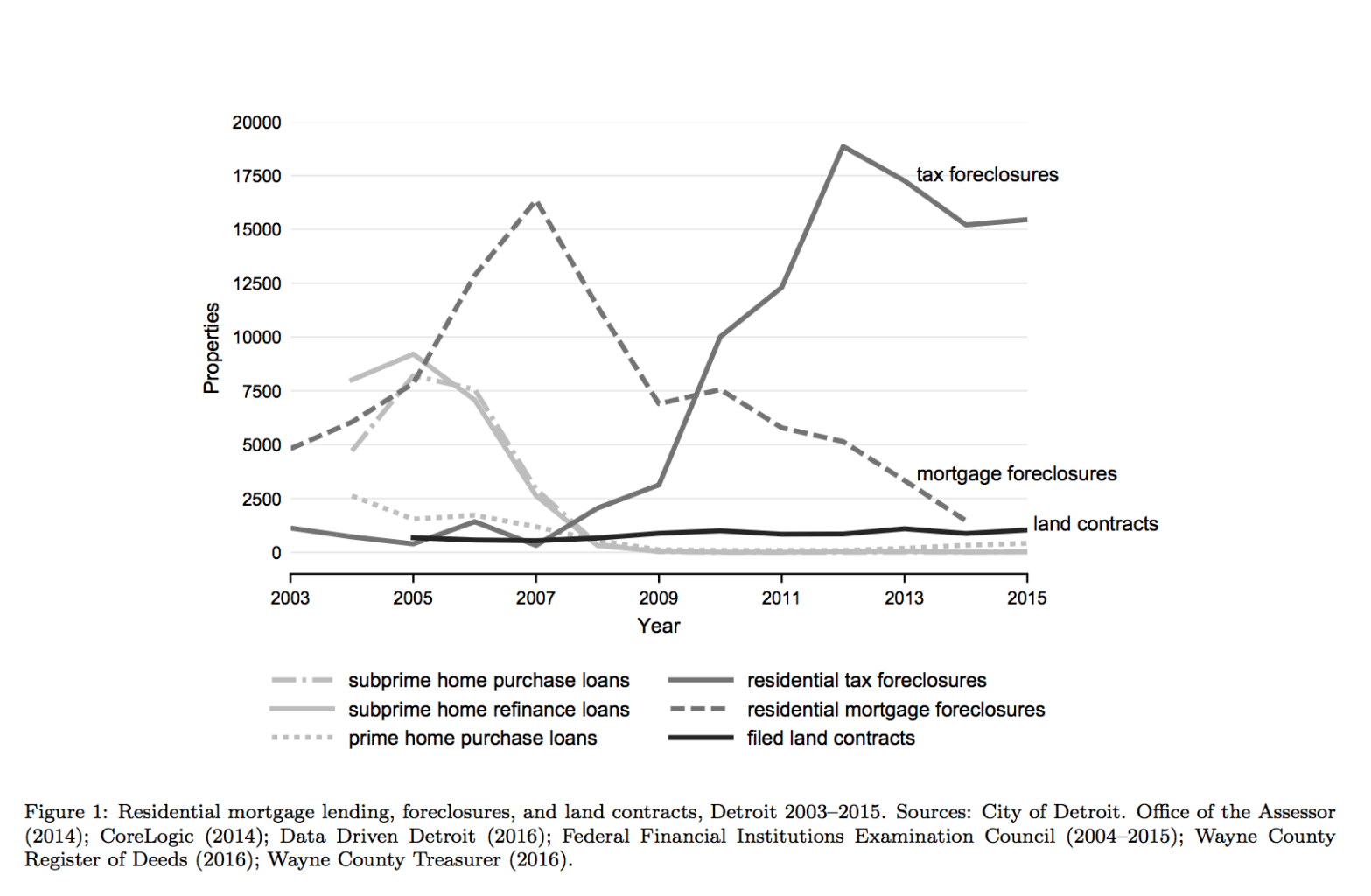
“In Detroit, land contracts outpace all other types of lending instruments for housing. … These instruments are incredibly flexible and allow for the possiblity of homeownership, but that flexibility also offers a lot of opportunity for exploitation.”

In late December, Urban Praxis’ Josh Akers was the guest on Wade’s World, a weekly broadcast on KABF in Little Rock focused on organizing and poor people’s campaigns around the world.

The topic of this show, hosted by longtime organizer Wade Rathke, ranged from tax foreclosures to land contracts and evictions and the work of organizations opposing speculators and displacement through direct action in Detroit.

You can listen the full episode here.

Akers and Seymour (2018) Instrumental exploitation: Predatory property relations at city’s end. Geoforum 91, 127-140.

Map: Paradise Valley, the Original Innovation District

Alex B. Hill's avatarDETROITography

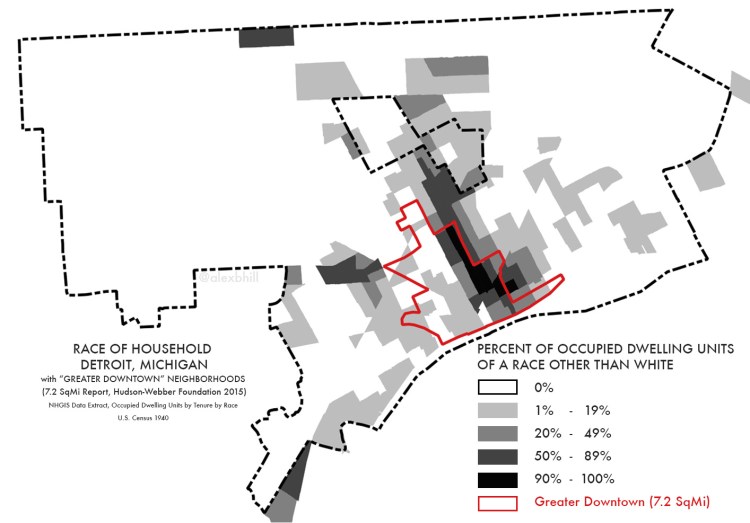
Race_Dwelling_1940-V2

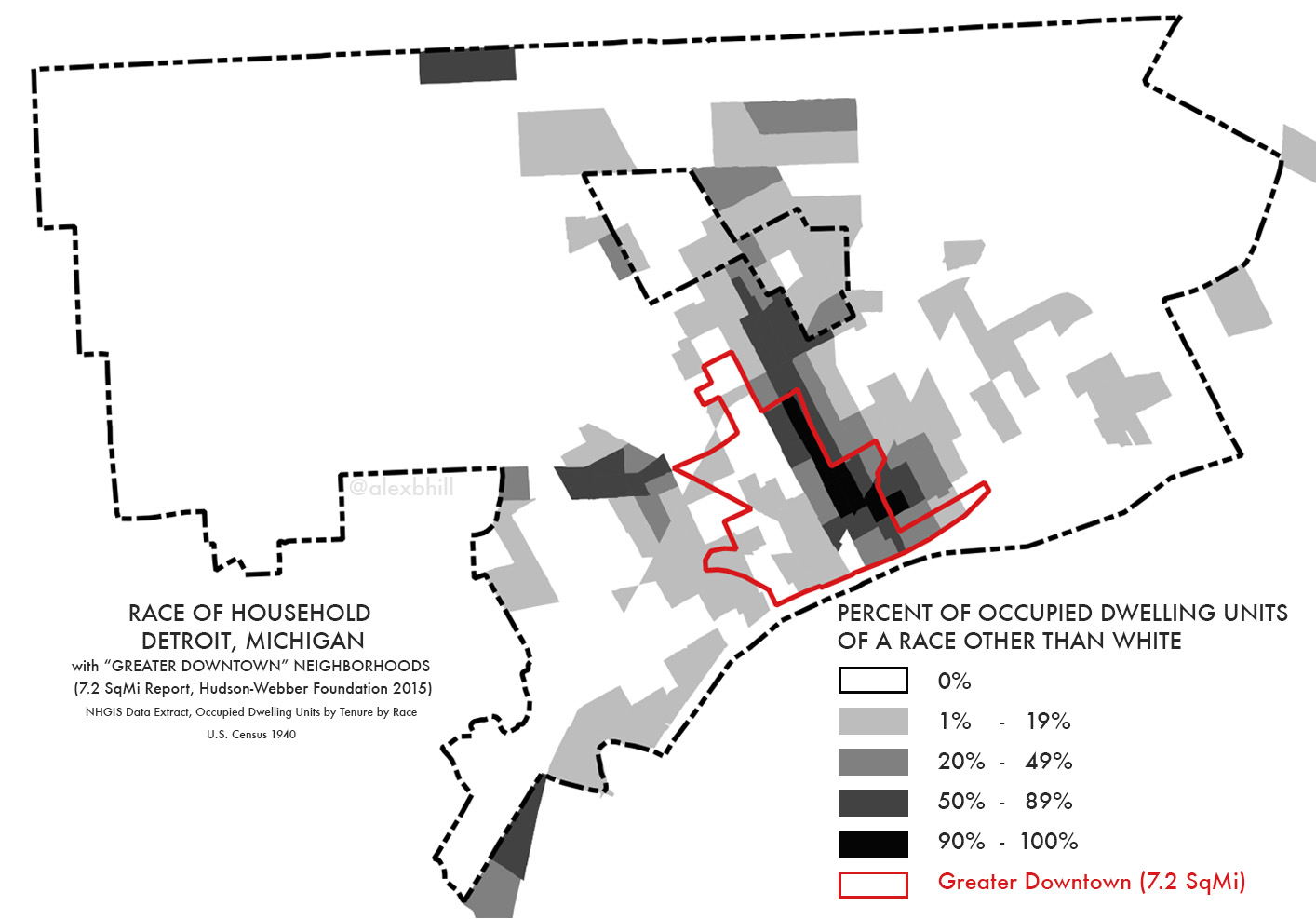
History is the most crucial context of any city. In thinking about the “lifecourse of place,” or the evolution of a particular geography over time, socio-demographics provide deep insight.

Detroit’s Black community was restricted in where they could legally purchase housing, so there had long been a concentration of Black households in the Paradise Valley area, north of Black Bottom.

Overlaying the current 7.2 square mile boundary onto this map of 1940s non-white households give stark contrast between history and current redevelopment.

Map originally presented by Josh Akers’ in a Book Review of Rebecca Kinney’s book, “Beautiful Wasteland: The Rise of Detroit as America’s Postindustrial Frontier.”

View original post